
Boat anodes for saltwater, often referred to as sacrificial anodes, are crucial for protecting submerged metal parts on boats from the harsh effects of saltwater corrosion. These anodes are commonly made from zinc, as it is highly effective in saltwater environments. When attached to the hull, propellers, or other metal components, they work by corroding first, thereby “sacrificing” themselves to protect the boat’s vital parts.
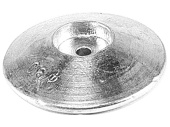
|
1-2 weeks delivery time Talamex Zinc Bolt-On Rudder Blade Anodes deliver durable protection for rudder blades in saltwater environments. With easy single-bolt installation, these anodes provide long-lasting defense against corrosion, ensuring the safety and longevity of your vessel.
|
$ 6.91
Weight, kg:
| ||
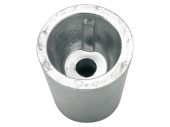
|
1-2 weeks delivery time Talamex Zinc Conical Propeller Anodes offer a secure and durable fit to protect your propeller shaft from corrosion in saltwater environments. With a unique conical shape, these anodes provide a tight installation, ensuring lasting defense against electrolysis.
|
$ 11.22
Diameter, mm:
| ||
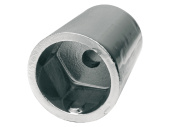
|
1-2 weeks delivery time Talamex Zinc 6-Side Propeller Anodes provide essential corrosion protection for propellers in saltwater environments. These six-sided zinc anodes ensure reliable anti-corrosion defense, helping to maintain your propeller’s performance and longevity.
|
$ 11.44
Diameter, mm:
| ||
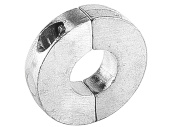
|
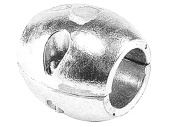
1-2 weeks delivery time Talamex Zinc Shaft Collar Anodes offer reliable corrosion protection for propeller shafts in saltwater environments. These ring-shaped anodes are easy to install with two bolts, providing robust defense for your vessel’s essential components.
|
$ 13.48
Diameter, mm:
| ||
|
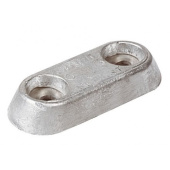
1-2 weeks delivery time Talamex Zinc Shaft Ball Anodes provide optimal corrosion protection for propeller shafts in saltwater. These oval-shaped zinc anodes are specifically crafted to safeguard your vessel, offering reliable, long-lasting performance.
|
$ 15.75
Diameter, mm:
| ||
|
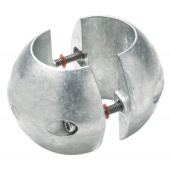
1-2 weeks delivery time Vetus Zinc Bolt-On Hull Anodes provide effective corrosion protection for vessels in saltwater environments. Made from high-quality zinc, they meet military standards (A - 18001 K). Available in sizes from 1.0 kg to 4.5 kg. Fasteners are sold separately. Ideal for steel, fiberglass, and wooden boats in salty and brackish waters.
|
$ 47.73
Type:
Weight, kg:
| ||
|
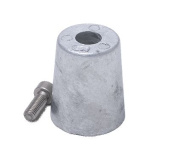
1-2 weeks delivery time Vetus ZINKAS Zinc Shaft Collar Anodes offer effective corrosion protection for shafts in saltwater environments. These anodes ensure reliable mounting, even as they erode. Available in various sizes from 25 mm to 60 mm shaft diameters. Fasteners are included. Not recommended for high-speed vessels due to potential imbalance during significant erosion.
|
$ 28.04
Diameter, mm:
| ||
|
1-2 weeks delivery time Vetus SN Zinc Propeller Anodes offer reliable corrosion protection for propellers and shafts. They are highly effective even under erosion, providing continuous protection. Easy to install and securely mounted to the shaft, they are ideal for yacht and boat owners seeking durable anode solutions.
|
$ 61.29
Diameter, mm:
| ||
|
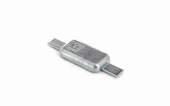
1-2 weeks delivery time Vetus WOA Zinc Weld-On Hull Anodes are designed for use in saltwater to provide reliable corrosion protection for boat hulls. Made from high-quality zinc, these anodes are available in both rectangular and teardrop shapes, offering long-lasting protection. Available in various sizes and weights, they ensure continued performance even as they erode.
|
$ 22.67
Type:
Weight, kg:
| ||
|
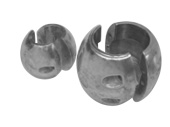
1-2 weeks delivery time TEC Zinc Propeller Shaft Ball Anodes are designed to effectively protect your propeller shaft from corrosion. These high-quality zinc anodes are available in various diameters from 18mm to 50mm, ensuring reliable protection for your vessel’s essential components.
|
$ 37.20
Diameter, mm:
| ||
|
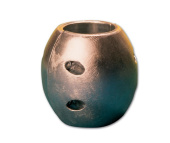
1-2 weeks delivery time The Hollex Aluminium Ball Shaft Anode is a spherical sacrificial anode designed to protect boat propeller shafts against corrosion in brackish and saltwater environments. Its steel core helps prevent the anode from becoming loose around the shaft. Available for shaft diameters of 22, 25, 25.4 (1"), 30, 35, 38, 40, 45, 50 and 60 mm. Manufactured from aluminium, the anode features a split ball-shaped design for installation around the shaft. Supplied individually.
|
$ 12.64
Diameter, mm:
| ||
|
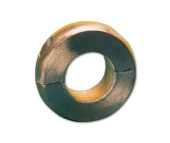
1-2 weeks delivery time The Hollex Zinc Ring Propeller Shaft Anode is a ring-shaped sacrificial anode designed for corrosion protection of propeller shafts in saltwater environments. It is installed against the front of the propeller and is available in 20 variants for shaft diameters from 22 to 130 mm. Manufactured from zinc, the anodes have external diameters ranging from 60 to 210 mm, depending on the selected shaft size. The range includes versions with anode thicknesses of 15, 18, 29, 30, 40 and 60 mm. Select the appropriate version according to the shaft diameter and required anode dimensions.
|
$ 9.26
Diameter, mm:
| ||
|
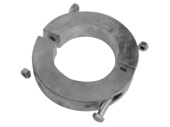
1-2 weeks delivery time E. Polipodio zinc shaft collar anodes for propeller shaft installations, available in 11 diameter configurations from Ø18 to Ø50 mm. The range includes models for 18, 20, 22, 25, 28, 30, 32, 35, 38, 40 and 50 mm shafts. The split ring-style collar construction allows the anode to be fitted around the shaft. Select the required version according to shaft diameter.
|
$ 26.23
Diameter, mm:
| ||
|
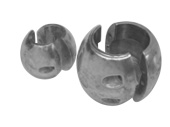
1-2 weeks delivery time E. Polipodio zinc propeller shaft ball anodes for shaft diameters from Ø18 to Ø50 mm. The range includes 13 configurations for 18, 22, 25, 25.4, 28, 30, 32, 34, 35, 38, 40, 45 and 50 mm shafts. The split ball-type construction consists of two halves fitted around the propeller shaft and secured with the supplied bolts. Select the required model according to shaft diameter.
|
$ 37.20
Diameter, mm:
| ||
What is the difference between aluminum and magnesium anodes for saltwater boats?
Aluminum anodes and magnesium anodes are both used to protect boats from galvanic corrosion in saltwater, but they differ in their properties and best applications. Aluminum anodes are commonly used in saltwater and brackish water environments due to their superior protection in these conditions, especially for boat hulls, outdrives, and trim tabs. Magnesium anodes, on the other hand, are best suited for freshwater environments or areas with low salt content, as they are more reactive and dissolve faster to protect metal components in those conditions. Both types of anodes work by sacrificing themselves to corrosion, preventing damage to the more noble metals of your boat.
Aluminum and magnesium anodes operate based on an electrochemical process, where they act as sacrificial metal anodes to prevent galvanic corrosion. In saltwater environments, the presence of dissimilar metals, such as in outboards or other metal components, can lead to corrosion if not protected. Aluminum anodes are ideal for saltwater and freshwater applications, as they are less reactive than magnesium but still effective in protecting metal surfaces. The sacrificial nature of these anodes ensures that the less noble metal corrodes instead of the critical components of your boat, extending the lifespan of your outboard and other parts exposed to saltwater.
How often should sacrificial anodes be replaced on a saltwater boat?
Sacrificial anodes on saltwater boats should typically be inspected every few months, and replaced when they've lost about 50% of their original size. The frequency of replacement depends on factors such as the type of water (saltwater or freshwater), the boat's usage, and the specific metal alloy of the anode. In saltwater, where the electrolyte solution is more corrosive, anodes may corrode faster and require more frequent replacement to effectively protect metal components like outboards and hulls from galvanic corrosion. Regular inspection ensures that the anode continues to "sacrifice" itself, protecting the boat’s metal surfaces from rust and oxidation.
Can boat anodes for saltwater also be used for other metal components like propellers and trim tabs?
Yes, boat anodes for saltwater can also be used for other metal components like propellers and trim tabs. These components, which are often made from metals such as aluminum or zinc, are susceptible to galvanic corrosion when exposed to saltwater. By using the appropriate sacrificial anode, such as zinc or aluminum, you can protect these parts by allowing the anode to corrode instead, effectively safeguarding the metal components of your boat from damage.