
Marine solar panels provide renewable electrical power for boats, yachts, and other vessels, helping support battery charging and onboard equipment when shore power or engine charging is limited. Depending on the installation, solar panels can be mounted on decks, coachroofs, arches, or other available surfaces and connected through a suitable solar charge controller to the vessel’s battery system. Marine solar panels are available in different sizes, power ratings, and construction types, including rigid and flexible designs. Correct panel selection depends on available mounting space, required energy output, system voltage, shading conditions, and the electrical demands of the vessel.
|
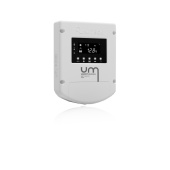
1-2 weeks delivery time Uniteck MPPT 30A solar charge controller provides high-efficiency energy conversion with adaptive charging algorithms, real-time LCD monitoring, and support for multiple battery technologies in larger solar systems.
|
$ 182.98
$ 196.76
-7%
Discount $ 13.77
-
+
| ||
|
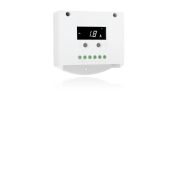
1-2 weeks delivery time Uniteck PWM 10A solar charge controller is a compact unit designed for small solar systems, offering stable battery charging, simple monitoring, and compatibility with multiple battery types.
|
$ 59.24
$ 63.70
-7%
Discount $ 4.46
-
+
| ||
|
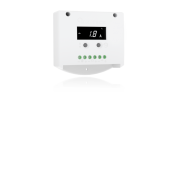
1-2 weeks delivery time Uniteck PWM 20A solar charge controller provides reliable solar charging for medium systems, supporting multiple battery types and offering simple real-time monitoring in a compact onboard design.
|
$ 72.40
$ 77.85
-7%
Discount $ 5.45
-
+
| ||
|
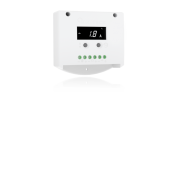
1-2 weeks delivery time Uniteck PWM 20A solar charge controller with 2 outputs regulates solar energy into stable battery charging, supports 12/24 V systems, and is compatible with AGM, GEL, lead-acid, and LiFePO4 batteries for compact onboard installations.
|
$ 151.38
$ 162.78
-7%
Discount $ 11.39
-
+
| ||
|
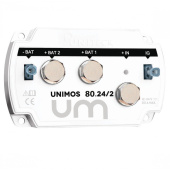
1-2 weeks delivery time Uniteck 80A MOSFET load splitter distributes charging current to two batteries with low voltage drop technology, preventing cross-discharge and improving efficiency in alternator and solar charging systems.
|
$ 143.48
$ 154.28
-7%
Discount $ 10.80
-
+
| ||
|
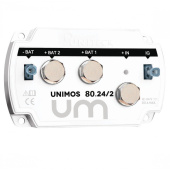
1-2 weeks delivery time Uniteck 120A MOSFET load splitter provides efficient dual-battery charging distribution with minimal voltage loss, ensuring battery isolation and stable performance in 12/24 V systems.
|
$ 182.98
$ 196.76
-7%
Discount $ 13.77
-
+
| ||
|
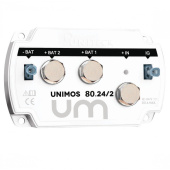
1-2 weeks delivery time Uniteck 160A MOSFET load splitter distributes charging current to up to three batteries, using low-loss MOSFET technology to prevent reverse discharge and improve charging efficiency in multi-battery systems.
|
$ 235.65
$ 253.38
-7%
Discount $ 17.74
-
+
| ||
|
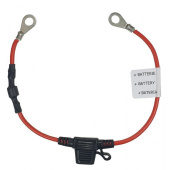
1-2 weeks delivery time Uniteck battery voltage reference cable is used with UNIMOS load splitters to enable correct charging activation from solar controllers or chargers, ensuring proper voltage sensing in compatible systems.
|
$ 28.95
$ 31.13
-7%
Discount $ 2.18
-
+
| ||
|
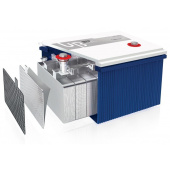
1-2 weeks delivery time Uniteck 100 Ah GEL carbon lead battery is a deep-cycle sealed battery designed for high discharge capability, long cycle life, and stable performance with low self-discharge for solar and marine use.
|
$ 401.53
$ 431.75
-7%
Discount $ 30.22
-
+
| ||
|
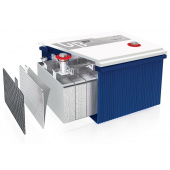
1-2 weeks delivery time Uniteck 150 Ah GEL carbon lead battery provides high-capacity deep-cycle storage with strong durability, long service life, and maintenance-free sealed construction for demanding energy systems.
|
$ 559.51
$ 601.62
-7%
Discount $ 42.11
-
+
| ||
|
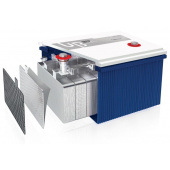
1-2 weeks delivery time Uniteck 220 Ah GEL carbon lead battery delivers high-capacity deep-cycle performance with carbon-enhanced technology, offering long cycle life, stable output, and safe sealed operation.
|
$ 717.48
$ 771.48
-7%
Discount $ 54
-
+
| ||
|
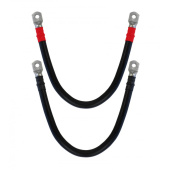
1-2 weeks delivery time Uniteck 25 mm² series battery cable is a short M8 connection cable designed for linking batteries in series or inverter systems, providing secure and stable power transfer.
|
$ 10.40
$ 11.18
-7%
Discount $ 0.78
-
+
| ||
|
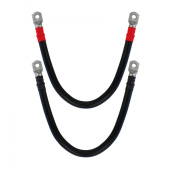
1-2 weeks delivery time Uniteck 35 mm² series battery cable provides reinforced high-current battery connection for series or inverter setups, ensuring stable energy transfer and secure M8 terminal connection.
|
$ 13.04
$ 14.02
-7%
Discount $ 0.98
-
+
| ||
|
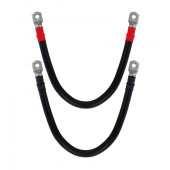
1-2 weeks delivery time Uniteck 25 mm² parallel battery cable set is designed for balanced battery linking in parallel systems, ensuring stable current distribution and reliable inverter or storage operation.
|
$ 26.98
$ 29.01
-7%
Discount $ 2.03
-
+
| ||
|
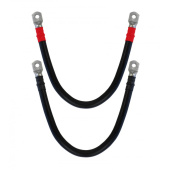
1-2 weeks delivery time Uniteck 35 mm² parallel battery cable set offers high-capacity parallel connection between batteries, providing efficient current sharing and stable performance in high-load systems.
|
$ 35.42
$ 38.09
-7%
Discount $ 2.67
-
+
| ||
|
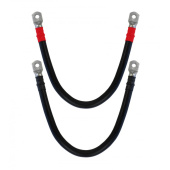
1-2 weeks delivery time Uniteck 50 mm² parallel battery cable set is designed for heavy-duty battery systems, enabling high-current transfer with secure M8 terminals for reliable inverter and storage applications.
|
$ 40.81
$ 43.88
-7%
Discount $ 3.07
-
+
| ||
|
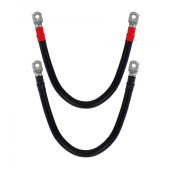
1-2 weeks delivery time Uniteck 1658 is a 25 mm² multiuse battery cable designed for series, parallel, or inverter connections, featuring M8-M8 terminals and a 40 cm length for compact installations.
|
$ 13.04
$ 14.02
-7%
Discount $ 0.98
-
+
| ||
|
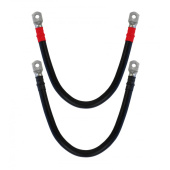
1-2 weeks delivery time Uniteck 1665 is a 35 mm² multiuse battery cable for flexible series, parallel, and inverter use, equipped with M8-M8 lugs and a 40 cm length for stable energy transfer.
|
$ 17.76
$ 19.10
-7%
Discount $ 1.34
-
+
| ||
|
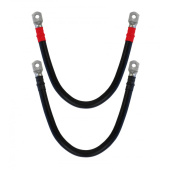
1-2 weeks delivery time Uniteck 1672 is a heavy-duty 50 mm² multiuse battery cable designed for high-current applications in series, parallel, or inverter systems, using M8-M8 terminals and a 40 cm length.
|
$ 21.72
$ 23.36
-7%
Discount $ 1.64
-
+
| ||
|
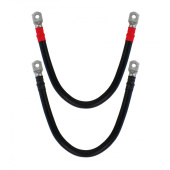
1-2 weeks delivery time Uniteck 1689 is a 70 mm² high-capacity multiuse battery cable built for demanding high-power systems, providing secure M8-M8 connections and strong current transfer over a 40 cm length.
|
$ 26.98
$ 29.01
-7%
Discount $ 2.03
-
+
| ||
How do marine solar panels differ from standard solar panels?
Marine solar panels are designed for installation on boats and yachts, where equipment must cope with moisture, salt exposure, vibration, movement, and limited mounting space. Depending on the model, they may use sealed electrical connections, corrosion-resistant materials, and lightweight constructions better suited to marine environments.
Marine panels are also available in rigid, semi-flexible, and flexible formats, allowing installation on different parts of the vessel such as roofs, arches, decks, and other suitable surfaces.
How do flexible and rigid solar panels differ for boats?
Flexible solar panels are lightweight and can follow slightly curved surfaces, making them useful where a conventional framed panel would be difficult to install. Rigid panels use a solid frame and protective front surface, providing a stable mounting platform and good long-term protection for the solar cells.
The best option depends on available space, mounting surface, ventilation, expected mechanical loads, and whether the panel needs to be removable or permanently installed.
How much power can a solar panel provide on a boat?
Solar output depends on the panel’s wattage, available sunlight, installation angle, temperature, and the amount of shading from masts, rigging, antennas, or other onboard equipment. A higher-wattage panel can provide more charging energy, but actual daily output will vary with operating conditions.
The required solar capacity should be selected according to the vessel’s battery bank and daily electrical consumption, including loads such as navigation equipment, lighting, refrigeration, pumps, and other onboard systems.
What equipment is needed to connect solar panels to a boat battery system?
A typical marine solar installation includes one or more solar panels, a suitable solar charge controller, wiring, connectors, fuses or circuit protection, and the onboard battery bank. The charge controller regulates the power from the panels and provides the correct charging profile for the connected batteries.
System voltage, panel output, controller capacity, battery type, cable size, and protection devices should all be matched correctly when designing the installation.