
Marine solar panels provide renewable electrical power for boats, yachts, and other vessels, helping support battery charging and onboard equipment when shore power or engine charging is limited. Depending on the installation, solar panels can be mounted on decks, coachroofs, arches, or other available surfaces and connected through a suitable solar charge controller to the vessel’s battery system. Marine solar panels are available in different sizes, power ratings, and construction types, including rigid and flexible designs. Correct panel selection depends on available mounting space, required energy output, system voltage, shading conditions, and the electrical demands of the vessel.
|
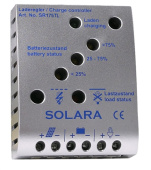
1-2 weeks delivery time The Solara 66P018001 is a charge controller supporting 12/24V systems up to 180 Wp, featuring protection against overcharging and full discharge, with indicator lights or LCD display for monitoring.
|
$ 112.02
$ 120.45
-7%
Discount $ 8.43
-
+
| ||
|
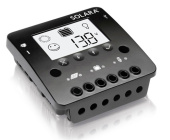
1-2 weeks delivery time The Solara 66P018002 is a 10A charge controller with an LCD display and 4-phase PWM charging, temperature compensation, and support for lead-acid and Lithium LiFePO4 batteries, including data storage and USB output.
|
$ 163.08
$ 175.35
-7%
Discount $ 12.27
-
+
| ||
|
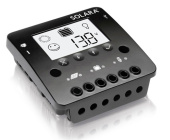
1-2 weeks delivery time The Solara 66P035002 is a 20A charge controller with an LCD screen, 4-phase PWM charging, and temperature compensation, supporting lead-acid and Lithium LiFePO4 batteries, with data storage and USB output, designed for single battery group use.
|
$ 250.69
$ 269.56
-7%
Discount $ 18.87
-
+
| ||
|
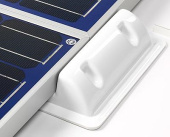
1-2 weeks delivery time The Solara 639000408 Mounting System Spoiler Connector White is a set of two white connectors designed to securely attach solar panel spoilers. Measuring 300 x 130 x 50 mm and weighing 0.5 kg, it is compatible with all solar panels for easy and stable installation.
|
$ 70.46
$ 75.77
-7%
Discount $ 5.30
-
+
| ||
How do marine solar panels differ from standard solar panels?
Marine solar panels are designed for installation on boats and yachts, where equipment must cope with moisture, salt exposure, vibration, movement, and limited mounting space. Depending on the model, they may use sealed electrical connections, corrosion-resistant materials, and lightweight constructions better suited to marine environments.
Marine panels are also available in rigid, semi-flexible, and flexible formats, allowing installation on different parts of the vessel such as roofs, arches, decks, and other suitable surfaces.
How do flexible and rigid solar panels differ for boats?
Flexible solar panels are lightweight and can follow slightly curved surfaces, making them useful where a conventional framed panel would be difficult to install. Rigid panels use a solid frame and protective front surface, providing a stable mounting platform and good long-term protection for the solar cells.
The best option depends on available space, mounting surface, ventilation, expected mechanical loads, and whether the panel needs to be removable or permanently installed.
How much power can a solar panel provide on a boat?
Solar output depends on the panel’s wattage, available sunlight, installation angle, temperature, and the amount of shading from masts, rigging, antennas, or other onboard equipment. A higher-wattage panel can provide more charging energy, but actual daily output will vary with operating conditions.
The required solar capacity should be selected according to the vessel’s battery bank and daily electrical consumption, including loads such as navigation equipment, lighting, refrigeration, pumps, and other onboard systems.
What equipment is needed to connect solar panels to a boat battery system?
A typical marine solar installation includes one or more solar panels, a suitable solar charge controller, wiring, connectors, fuses or circuit protection, and the onboard battery bank. The charge controller regulates the power from the panels and provides the correct charging profile for the connected batteries.
System voltage, panel output, controller capacity, battery type, cable size, and protection devices should all be matched correctly when designing the installation.