
Boat dock whips are flexible mooring systems designed to hold a boat away from the dock while still allowing controlled movement caused by wind, waves, and wake. They are commonly installed on docks and pontoons where maintaining separation between the hull and dock structure helps reduce contact and impact. Boat whips, mooring whips, mooring poles, and mooring arms are available in different lengths, strengths, and mounting configurations to suit various boat sizes and berth layouts. Correct selection should consider vessel size, weight, expected environmental loads, dock geometry, and the distance required between the boat and the dock.

|
1-2 weeks delivery time Dock Edge Premium Mooring Whips use multi-stage, triple cross-wound construction to provide the strength and flexibility required to maintain a safe distance between the boat and dock. The system features roller tips, solid cast aluminum bases with built-in cleats and eyelets, aluminum tensioners, and a plug-and-socket design for quick separation. Available in 2.4, 3.7, 4.3 and 4.9 m lengths, covering boats up to 10 m and 9070 kg, depending on model.
|
$ 523.58
Type:
Item:
| ||

|
1-2 weeks delivery time Dock Edge Economy Mooring Whips use flexible fiberglass poles to maintain a safe distance between the boat and dock, helping prevent impacts caused by waves and passing-watercraft wakes. The complete set includes 2 fiberglass whips with roller tips, 2 solid cast aluminum bases with built-in cleats and eyelets, 2 aluminum tensioners, 2 whip lines, and 2 mooring lines. Available in 2.4 m and 3.7 m lengths for boats up to 5.5 m / 900 kg and 7.0 m / 1800 kg respectively.
|
$ 432.38
Type:
Item:
| ||
|
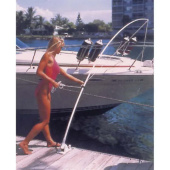
1-2 weeks delivery time The Brunger Mooring Whips are designed to keep boats and tenders safely away from docks, seawalls and neighbouring vessels, reducing the risk of hull damage and fender wear. Manufactured from flexible tapered polyester rods, they provide controlled deflection while maintaining a safe distance from fixed structures. Each complete kit includes a pair of mooring whips, cast aluminium bases, mooring lines, cleats and mounting hardware. Four models are available for boats from under 5 m up to 8.5 m and displacements of 1,133–9,071 kg.
|
$ 1,188.95
Type:
Item:
| ||
What are boat dock whips used for?
Boat dock whips are used to hold a vessel away from the dock while allowing controlled movement as wind, waves, and wake affect the boat.
They help maintain a consistent separation between the hull and dock structure and can reduce repeated contact during normal mooring.
How do mooring whips work?
Mooring whips use flexible poles or arms mounted to the dock. Lines connected between the whip system and the vessel create outward tension that helps keep the boat positioned away from the dock.
The flexible sections bend as the boat moves, allowing the system to absorb and control movement rather than holding the vessel rigidly in one position.
How do I choose the correct boat whips?
Boat whips should be selected according to vessel length, displacement, beam, expected wind and wake loads, berth dimensions, and the required distance between the boat and dock.
The mounting system and dock structure must also be suitable for the loads created by the installed whip system.
What is the difference between mooring poles and mooring arms?
Both terms can describe equipment used to control the position of a boat relative to the dock. Mooring poles are typically flexible upright members, while mooring arms may refer to rigid or articulated systems that maintain spacing between the vessel and dock.
The exact design and operating method depend on the specific mooring system.
Are dock whips suitable for different boat sizes?
Yes, but the whip system must be sized for the vessel. Larger or heavier boats require greater load capacity and stronger mounting arrangements than smaller craft.
Manufacturer recommendations for vessel size and maximum load should always be checked before installation.
What should be checked during maintenance of boat dock whips?
Inspect the whip poles or arms, mounting bases, lines, fasteners, and connection points for wear, cracks, corrosion, deformation, or looseness.
Lines should also be checked for abrasion and UV degradation, and damaged components should be replaced before further use.